Updated 2026-09-09 · 4 min read
What is a CDU (coolant distribution unit)?
Key takeaways
A CDU (coolant distribution unit) is the heart of a rack liquid cooling system: it pumps coolant through the cold plates on servers and transfers the captured heat to a final heat sink — either facility water (liquid-to-liquid) or room air (liquid-to-air). Liquid-to-air CDUs make cabinets facility-free but their capacity derates as room temperature rises; liquid-to-liquid CDUs handle far more power but need building water loops. A CDU also isolates the clean server loop from facility water, filters the coolant, and controls temperature, flow and pressure.

What it actually does
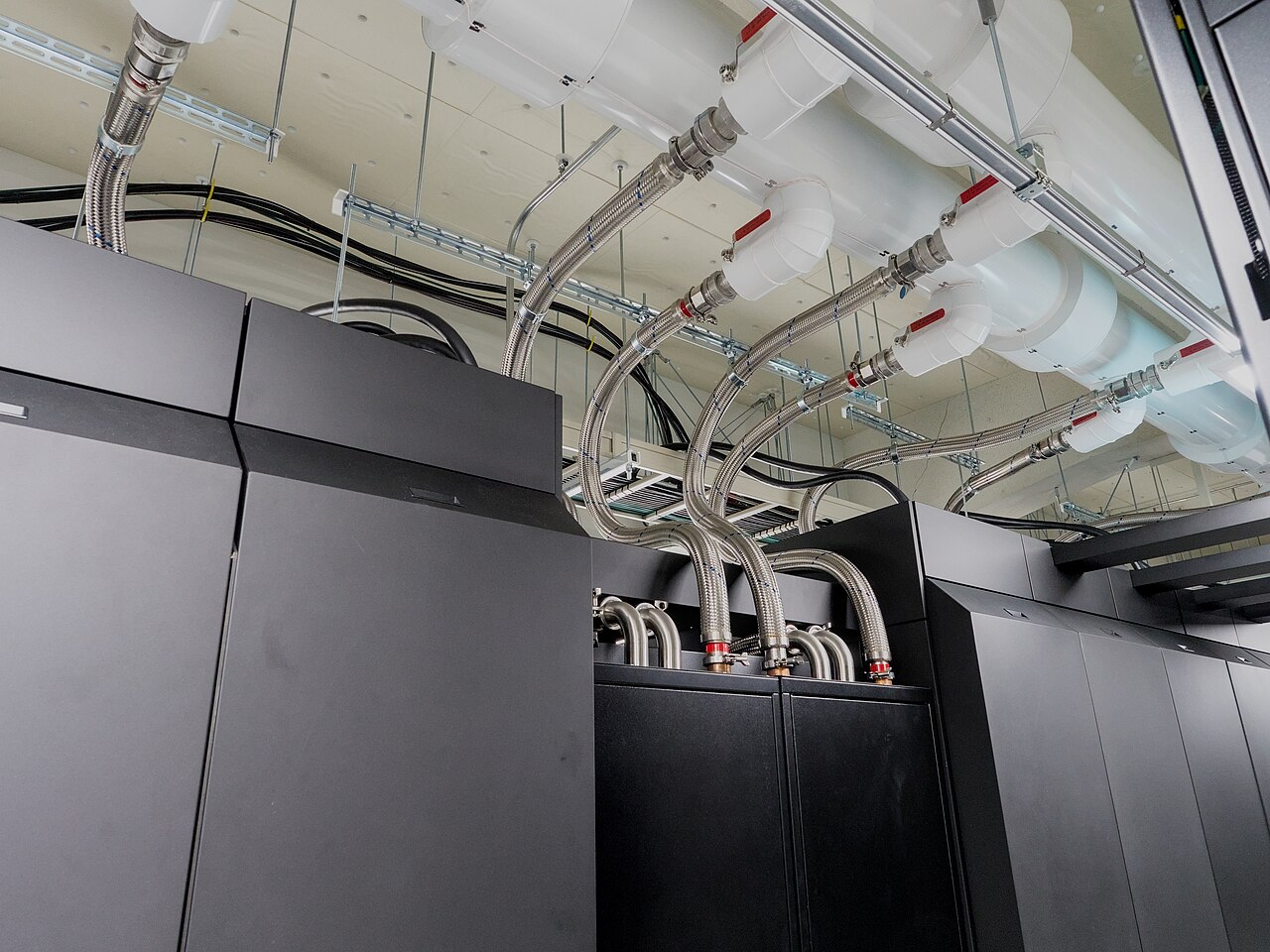
Every direct-to-chip system has two loops. The technology cooling system (TCS) is the clean, closed loop flowing through server cold plates. The facility water system (FWS) is the building's water. The CDU sits between them: pumps drive the TCS loop, a plate heat exchanger hands heat to the FWS (or to a fan-driven radiator in liquid-to-air units), and instrumentation keeps coolant temperature, flow rate and pressure inside spec — protecting the servers from whatever is happening on the facility side.
The three form factors
| Form | Where it lives | Typical reach |
|---|---|---|
| In-rack CDU | Inside the cabinet (a few U) | One rack — the micro-DC pattern |
| In-row CDU | Standing between racks | A row of racks (70-350 kW class) |
| Facility CDU | A plant room | A whole data hall |
Liquid-to-air vs liquid-to-liquid
Liquid-to-air (L2A) CDUs — sometimes "sidecar" units — blow the heat into the room, trading peak capacity for zero plumbing: nothing to connect outside the cabinet. Liquid-to-liquid (L2L) CDUs connect to facility water and scale to hundreds of kW per unit, but a room without a water loop cannot use them at all. For hospitals, universities and edge sites, that is usually the whole decision.
Buying questions
- Capacity at your room temperature, not at 25°C lab conditions — ask for the derating curve.
- Pump redundancy (single pump = single point of failure for the whole rack).
- Coolant filtration and chemistry management (PG25 systems need it too).
- Alarm and telemetry interfaces — remote sites live or die by monitoring.
Frequently asked questions
What does a CDU do in liquid cooling?
A coolant distribution unit (CDU) circulates coolant through the cold plates mounted on servers and transfers the absorbed heat to a final heat sink. It also isolates the clean server loop from facility water, filters coolant, and regulates temperature, flow and pressure to keep servers safe.
What is the difference between liquid-to-air and liquid-to-liquid CDUs?
Liquid-to-air (L2A) CDUs reject heat into room air via fans and a radiator — no building water needed, but capacity falls as room temperature rises. Liquid-to-liquid (L2L) CDUs exchange heat with a facility water loop and scale far higher, but require the building to have chilled or tempered water infrastructure.
Do I need a CDU for a single cabinet?
For direct-to-chip cooling, yes — some device must pump the loop and reject the heat. In single-cabinet deployments the CDU is usually built into the cabinet itself (in-rack CDU), which is what makes a "liquid cooling cabinet" self-contained.